
RESCUE holds policy roundtable in Brussels
By Editor
RESCUE roundtable discuss climate modeling insights on carbon dioxide removal under overshoot and no-overshoot scenarios, and their relevance for climate policy.
On 2 June 2026, the RESCUE project convened a policy roundtable in Brussels to discuss climate modeling insights on carbon dioxide removal (CDR) under overshoot and no-overshoot scenarios, and their relevance for climate policy. A group of 10 scientists from RESCUE affiliated research institutions had a close conversation with about 20 policymakers from EU Commission directorates, NGOs and think tanks.
The morning session opened with a keynote from Dr Jan Minx presenting the third edition of the State of CDR report, launched the same day. It set the scene with a central message: national pledges currently cover only 40% of the CDR needed for a 1.5°C pathway by 2050, a gap that policymakers need to close within the next four years.
RESCUE scientists then presented results from Integrated Assessment Models (IAMs) and Earth System Models (ESMs), comparing overshoot peak and decline and non-overshoot scenarios, and their implications for CDR efficiency, related climate impacts and reversibility of impacts. Using the example of BECCS potential, scientists highlighted how the two modelling approaches address complementary questions but diverge in underlying assumptions, uncertainties and estimates.
For instance, differing assumptions in the models about future crop yields lead to substantially different projections on BECCS deployment. While projections from both ESMs and IAMS show that delayed mitigation increases risks for extreme events such as heatwaves, even when global temperatures have already decreased after an overshoot period, overshoot also increases reliance on future CDR, which increases land-use competition and need for investment in new technologies such as OAE. The discussion centered around competition between BECCS and natural forest areas, and trade-offs between ecosystem protection and related cost increases for BECCS, agriculture and food supply.
The afternoon session turned to specific CDR options. The terrestrial CDR presentation focused on afforestation/reforestation (AR) and BECCS, highlighting that overshoot increases fire risks and biodiversity loss, and that these impacts are not quickly reversible once temperatures begin to decline. The marine CDR presentation focused on OAE, showing that its climate benefits depend heavily on simultaneous progress in decarbonizing the energy system, and that localized deployment has implications beyond national boundaries, with need for international governance and MRV frameworks.
A central discussion point was the importance of clear and consistent definitions around removals, afforestation, and land-use categories, which was seen as key for transparent policy action and communication. The discussion also highlighted uncertainties around biomass supply, reinforcing the need for robust sustainability criteria under the Renewable Energy Directive (RED).
The roundtable forms part of RESCUE’s ongoing science–policy dialogue. A policy brief on OAE is forthcoming, with a final synthesis report expected at the end of 2026. RESCUE results will also feed into international initiatives such as CDRMIP and the IPCC 7th Assessment Report.
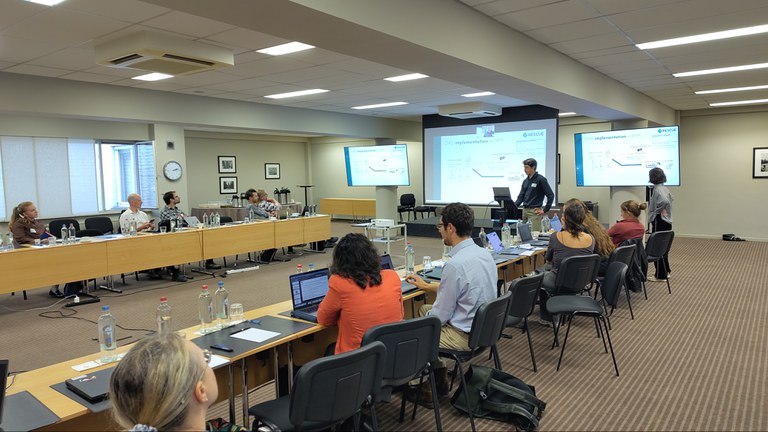
Project partners and policymakers at roundtable held in June 2026